Anyone is welcome to contact us to contribute more history to this page. More history would be very much appreciated.
Today in present times, we are still in an ice age that began 2.6 million years ago. It can be called the Quaternary Glaciation or just simply the current ice age. It's been a period of glacial and interglacial periods. Right now, we are in an interglacial period. But during the last glacial period, the climate was much colder. The cold climate had a lot to do with Earth being in a more elliptical orbit. The Earth was closest to the sun during the Northern Hemisphere's summer and furthest during it's winter. This is opposite to how it is now. This led to summers that were a little cooler, and winters that were much colder than today. There was also greater variation in the year to year weather. Around 16,500 years ago, the area where Scott Lake is today was covered by the Cordilleran ice sheet. The Cordilleran ice sheet started up in Alaska and Canada, and ended just a few miles south of where Scott Lake is today. The climate in the local area was very dry. Average year-round temperatures were about 5 to 7°C (9 to 13°F) colder than in present times. Even though the climate was significantly colder than it is today, it still wasn't cold enough to keep the ice frozen throughout the year. But the ice was pushing in from the north faster than it was melting. According to Tim Walsh, the Washington State Chief Geologist, when the climate began warming and the ice sheet started receding, a chunk of ice detached itself from the ice sheet. The melting ice sheet produced streams which carried sediments down to the chunk of ice. Those sediments partially buried the chunk of ice. The chunk of ice left a depression in the ground called a kettle. As the ice chunk melted, the kettle began filling up with water and becoming the kettle lake we call now call Scott Lake.
Here's some information about the Pacific Northwest during the last glacial period: http://www.fs.fed.us/rm/pubs/rmrs_gtr292/1992_whitlock.pdf
Here's a map showing the geologic history of the Scott Lake area: http://www.dnr.wa.gov/Publications/ger_gm72_geol_map_maytown_24k.pdf
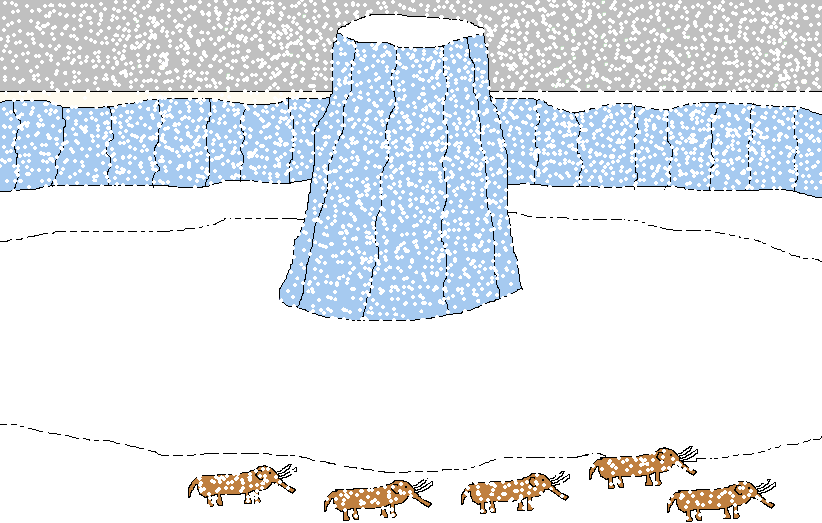
This is a drawing of what the new forming Scott Lake may have looked like.
This is the first known written record that mentions the lake. The lake had no known name at the time. The survey was done by Josiah W. Preston on August 21, 1853. This is noted under Field notes of land surveys in Washington, Volume 3, Pages 59 and 60.
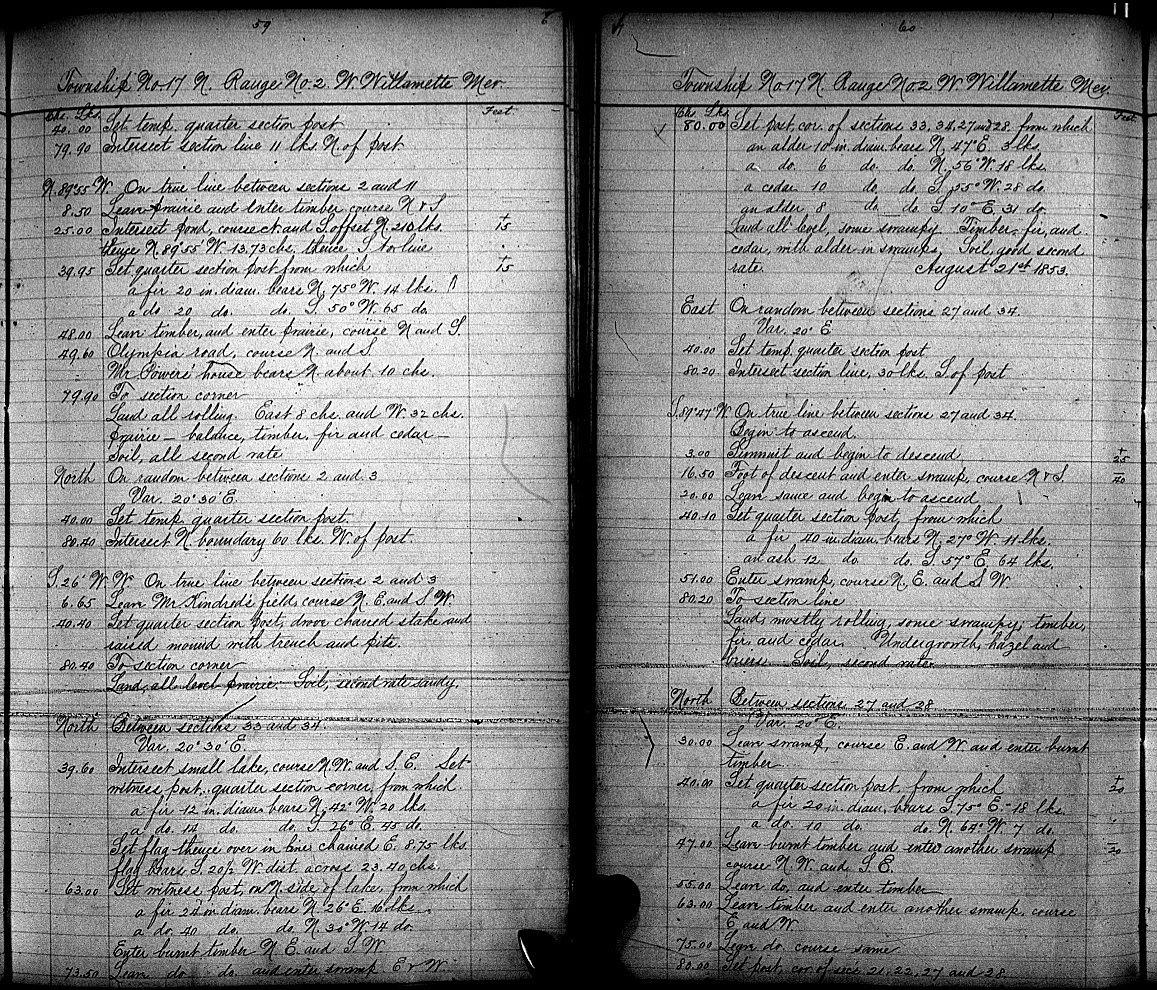
| North | Between sections 33 and 34 |
| Var. 20° 30' E | |
| 39.60 | Intersect small lake, course N.W. and S.E. Set |
| witness post, quarter section corner, from which | |
| a fir 12 in. diam bears N. 42° W. 20 lks. | |
| A do. 14 do. do. S. 26° E. 45 do. | |
| Set flag thence over in line chained E. 8.75 lks. | |
| Flag bears S. 20½ W. dist. Across 23.40 chs. | |
| 63.00 | Set witness post, on N side of lake, from which |
| a fir 24 in. diam. Bears N 26° E. 16 lks. | |
| A do. 40 do. do. N 30° W. 14 do. | |
| Enter burnt timber N.E. and S.W. | |
| 73.50 | Leave do. do. And enter swamp E & W. |
| chs. lks. | |
| 80.00 | Set post, cor. Of sections 33, 34, 27 and 28. From which |
| an alder 10 in. diam. Bears N. 47°E. 3 lks. | |
| A do 6 do. do. N. 56°W. 18 lks. | |
| A cedar 10 do. do. S. 55°W. 28 do. | |
| An alder 8 do. do. S. 10°E. 31 do. | |
| Land all level, some swampy. Timber, fir, and | |
| Cedar, with alder in swamps. Soil, good second | |
| rate. August 21st 1853. |
On page 72 of Volume 3, in a general description of the township it states, “The quality of the soil is rather below the common average of the Townships adjoining the highland being of a gravelly nature, and the swamps so low and wet that they are unfit for cultivation as very few can be drawed [sic] at all. Sections 19, 20, 28, 29, 30, 31, 32 and 33 were deemed unfit for cultivation and impracticable to survey being an immense swamp, and cranberry marsh, which in the driest season is mostly covered with water. There are but few settlers, and they are the oldest in the country, having settled in 1848.”
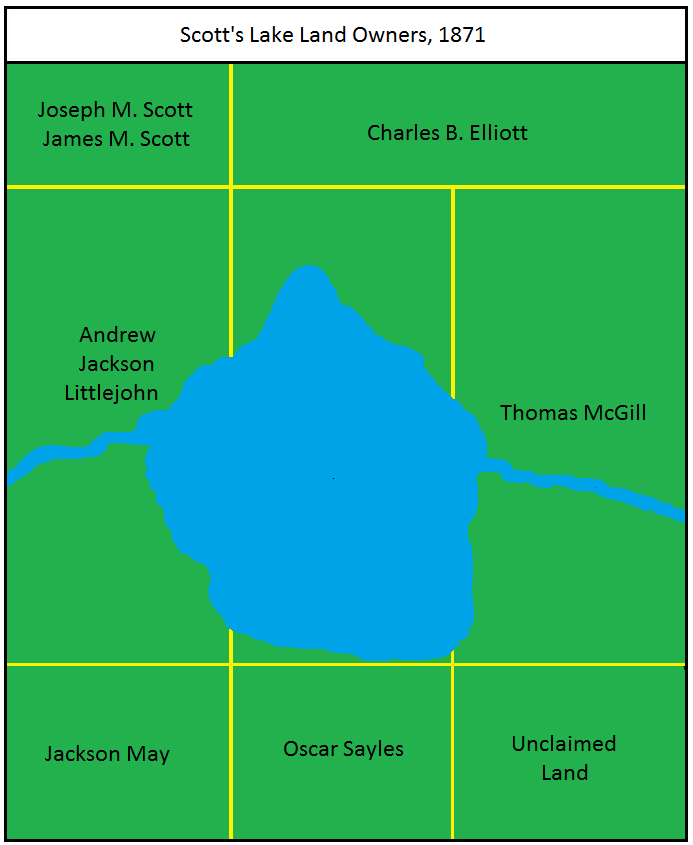
An early map titled Thurston Taxable Land, 1871 shows J.M. Scott as a land owner next to the lake. According to the Bureau of Land Management site http://www.glorecords.blm.gov/search/, those owners were Joseph M. Scott and James M. Scott. James and Joseph Scott were granted the land patent on their 160 acre (64.7 hectare) homestead on September 1, 1869. They were the first people to obtain a land patent on any land next to the lake. If they got their patent in 1869, that means that they first started homesteading the property in 1864 or before because a person or family had to live on the homestead at least five years in order to get a land patent. The United States Census of 1880 shows that James was not living on the property, only Joseph Scott and his wife Mary Scott lived there. It shows that Joseph was born in the state of New York in circa 1830, and Mary was born in Maine in circa 1840. Joseph's occupation was “Farmer”, and Mary's occupation was “Keeps House”. When Joseph Scott first moved to the lake, he would have been around 34 years old.
The Scotts lived through the rainiest 12 month period in recorded history. From February 1879 to January 1880, the Olympia Army Signal Corps recorded 87.18 inches of rain.
Andrew Jackson Littlejohn was an early property owner that came shortly after the Scotts'. A good portion of the Scott Lake Community today used to be Andrew Littlejohn's property. The census of 1870 shows that Andrew Littlejohn's property was worth $800.
There was a one room school called Independence School that served the Scott's Lake area from 1891 to 1918. It was at one of the Case Road intersections (Source:A Rich Heritage, Tumwater Area Schools by Don Trosper, page 33). According to a google map on historic schools in Thurston County, it's located on what's now Case Extension Road across the street from Scott Lake Grocery. https://maps.google.com/maps/ms?msid=201013474818666390304.0004c03d21bf83d8625d6&msa=0&dg=feature
This is what the January 2, 1900 Morning Olympian newspaper article said about the December 25, 1899 shooting. This article was written before January 1, 1923, so the copyright has expired and is in the public domain.
“A NEIGHBORHOOD ROW
It Will Engage Justice Schomber This Afternoon
The results of a neighborhood quarrel that took place on Scott's lake, near South Union, on Christmas day will be investigated by Justice of the Peace Schomber this afternoon. The case comes before the justice in the shape of a complaint sworn to by Fred Green, who charges Robert Nicholson with shooting at four boys on that day, the youngsters being Arthur Green, George Green, Thomas Pearce and Terrance Pearce, without provocation. It is also charged that on the following day Nicholson threatened to do bodily harm to Ralph Pearce and his son, Terrance Pearce. It appears from what can be learned that Scott's lake is a favorite hunting resort for the boys of that neighborhood and that Nicholson, who lives on its banks, is annoyed greatly thereby. On Christmas the boys as usual were hunting on the lake and it is said Nicholsoon fired the contents of a shotgun at them and the shot fell all around them. For his part Nicholson says he fired over their heads to scare them away. The next day Ralph Pearce and his son were hunting on the same lake and it is alleged Nicholson told them if they did not at once desist he would shoot them. It is known that as a result of this the elder Pearce and Nicholson almost came to a personal encounter. Justice Schomber at 1 o' clock today will endeavor to get at the straight of the whole matter and mete out justice accordingly.”
Next day's article written January 3, 1900
“IN BONDS OF $200
Robert Nicholson Must Keep the Peace for One Year
Robert Nicholson, of South Union, was arraigned before Justice Schomber yesterday to answer to the charge of assault with a deadly weapon alleged to have been committed on Christmas day near South Union. Beofe the hearing began a consultation between the county attorney and Nicholson's attorney resulted in the decision not to prosecute the charge against Nicholson, who is an old man and has a violent temper when aroused. It was determined, however, to have Nicholson bound over to keep the peace for one year and he was also compelled to be responsible for the costs. Justice Schomber therefore put him under a bond of $200 to keep the peace and taxed $15 costs against him. During the year referred to the defendant will have the charge of assault with a deadly weapon hanging over him, and should be again break the peace he will be prosecuted under it. He was given until January 15 to secure the bond and complete paying the costs, in order to accomplish this it is said he must mortgage his home at Scott's lake, as he is a poor man and has no other resources. On the whole, with such a charge against him he got off very lucky.”
On Sunday, March 10, 1907, there was a baptism at Scott's Lake. Here's what the Morning Olympian article stub from March 12th said.
“Rev. E. Slimp of South Union baptized Mr. and Mrs. Vollmer and Miss Pearl Davis in Scotts Lake Sunday.”
Reverend E. Slimp was pastor of a church that does not exist anymore. This should not be confused with the South Union Church of God which was built decades later. Very little is known about the first South Union Church. Nobody even knows the exact location or if the building still exists today.
This is what the Morning Olympian article from March 4, 1914 said.
“DR. P. W. BRAGDEN IS PARTIAL TO THURSTON
Dr. P. W. Bragden, who recently purchased a 40 acre tract of land on Scott's Lake, seven miles south of Olympia was in the city Monday. Dr. Bragden, who is a dentist and who was a former school fellow of Dr. P. H. Carlyon at the Philadelphia Dental College in 1883, was obliged to give up his profession on account of ill health. “I traveled a great deal through Oregon and Eastern Washington.” Dr. Gragden [SIC] said, “in search of some locality that would suit me better than Puget Sound, but I am back again, satisfied that such a place is not to be found. Puget Sound suits me.””
This is a quote from the newspaper article titled SPORTSMEN PLAN PICNIC AT LONG LAKE NEXT MONTH from the Olympia Daily Recorder written May 26, 1920.
“A committee from the association accompanied by Ben King, county game warden, visited what is known as Scott's Lake to ascertain whether it would be a favorable lake for the planting of trout and after considering the matter the association went on record as recommending to the game commission that it make steps to stock this lake in the near future. This lake lies some nine miles south of Olympia near South Union.”
According to The Morning Olympian article from July 1, 1920, the sportsmen and the game commission placed 60,000 silver trout in Scott's Lake.
There was a picnic with 23 guests at a house on Scott Lake on Friday, June 4, 1920. Here's what the newspaper Olympia Daily Recorder said about it the next day.
“Miss Wynne Bragdon entertained with a most delightful picnic Friday evening at the home of her mother, Mrs. G.W. Bragdon, on Scott Lake, about 10 miles south of Olympia. The party motored out late into the afternoon and upon their arrival were served with supper outdoors. Following the picnic games were enjoyed and later in the evening the young people gathered about a large bonfire and had a merry time singing and story telling. Those who enjoyed the evening were Gladys Holcomb, Ruth Elberson, Betty Lamborn, Dorothy Rose, Ruth Peters, Helen Lord, Maxine Holcomb, Mary Owings, Virginia Kuhns, Miriam Elwait, Helen Littlejohn, Wynne Bragdon, Orval Kisor, Oscar Bulluck, Merritt Mills, Arthur Marshall, Charles Lyman, Ray Fleaharty, Waldo Stentz, Ottmar Kotick, Charles Tyler, Virgil Baker, Edwin Allen and Ernest Barnes.”
This is what the Morning Olympian article from May 13, 1922 said.
“A.J. LITTLEJOHN, THURSTON PIONEER, DIES AT AGE OF 78
Andrew J. Littlejohn, age 78, a pioneer of Thurston and Pierce Counties, died Thursday afternoon at 4:15 at his home in Tacoma. He is survived by his widow, Mrs. A. J. Littlejohn, one brother, William Littlejohn of this city, and a sister, Rebecca J. French of Grand Mound. Funeral services will be held Saturday afternoon at 3 o' clock from the Buckley-King company and will be in charge of lodge No. 68 F. & A. M. of Tacoma, of which deceased was a member. Burial will be at Oakwood cemetery.
Mr. Littlejohn was born in Indiana in 1844, and crossed the plains by ox team when he was 8 years old, in 1852. The family first settled in what was then Vancouver, Oregon, now Vancouver, Wash., and Mr. Littlejohn afterwards came to Thurston County where he spent 30 years, moving to Tacoma 20 years ago, where he engaged in the real estate business.”
From August 13, 1929 to August 18, 1929, the Grand Mound 4-H Community Club held a summer camp at Scott Lake. The camp had swimming and boating during the day, and campfire meetings at the end of the evenings.
Here's what Caleb A. Maki from the Washington State Board on Geographic Names said July 21, 2009 about the Scott Lake name.
“The official name of the lake is Scott Lake. Scotts Lake is listed as a variant in the GNIS (http://geonames.usgs.gov/domestic/index.html). The GNIS was populated originally in 1979 when the USGS took all names currently on their Quad Maps, and entered them as is.
Variant names usually come from other maps that the US BGN was aware of (i.e. Forest Service Maps), as well as published names from various sources. Also, if a feature is shown to be named incorrectly, the incorrect name is sometimes labeled as a variant name.
Prior to 1979, it is very difficult (if not impossible) to say how the name came to be, or why it has changed over the years. Often, these changes are by a cartographer changing a name to fit the map, or if the cartographer has heard of another name for the feature.
In the case of Scott Lake, I did find a reference in “Lakes of Washington: Volume I” that cites the name coming from a 1950 State Dept of Game map.
I am only guessing here, but usually a cartographer often adds an S at the end of names to show ownership. So I can see how the lake was called Scott's Lake on some maps. To further complicate things, most cartographers' drop any apostrophes to save space, so it would become Scotts Lake.”
Prior to 1920, most newspaper articles refer to the lake as Scott's Lake. During 1920, some articles say Scott's Lake and some say Scott Lake. After 1920, they all seemed to say Scott Lake. However, the maps continued to call it Scotts Lake, but without the apostrophe. The Metskers Atlas of Thurston County Washington, 1929 shows the name as Scotts Lk. The Enumeration District Map, 1940 says Scotts Lake. Later on, the USDA soil map issued in 1958 from a 1947 survey shows the name as Scott Lake. The Metskers Atlas of Thurston County Washington, 1948 and all later editions show the name as Scott Lk. The State Department of Game, Survey of 1950 shows the name as both Scott Lake and Scotts Lake.

Enumeration district map from 1940 showing Scotts Lake
According to a July 19, 2006 article from the Chinook Observer, Gene and Jinx Collins and their little daughter Kathi rented and lived on a 398 acre farm at Scott Lake. Gene would buy and sell quarter horses. He and his daughter would shoe horses for $6.00 per head.
Inflation Calculator (1913 to present): http://data.bls.gov/cgi-bin/cpicalc.pl
Dan Moody tells about when he and his father Jack Moody would purchase and cut Christmas trees on the Collins farm to sell at their Christmas tree stand.
The Scott Lake Development Company purchased the land that the Collins family were living on to turn it into the Scott Lake community. The community of Scott Lake officially began on March 29, 1962. This is the date that the Scott Lake Development Company filed with the state as a corporation.
Weather for Olympia Municipal Airport on March 29, 1962
Source: National Climatic Data Center
High Temperature: 65°F
Low Temperature: 25°F
Average Temperature: 45°F
Precipitation: 0.00”
Average Wind Speed: 3.3 mph NE
Highest Wind Gust: 13 mph NE
Percent Cloud Cover: 0%
The second family to move to Scott Lake was Charley and Viola Johnston. They had their home built on Lake Shore Drive (now called 113th Way).
During the early years of being a community, McCorkle Road (now called 113th Avenue) had no bridge. The road intersected Interstate 5.
In 1962, Louis and Ilona Nozsar were the first owners of the Scott Lake store. They purchased the land from the Scott Lake Development Company for $3,595 dollars and signed the real-estate contract on August 1. They paid for the construction of the store building. The store is remembered as being some kind of café.
In 1968, Bill and Bertha Monfort bought the store from Louis and Ilona Nozsar for $5,500. It is unknown what kind of business it was when Bill and Bertha Monfort owned the store.
Later on, Perry and Edna Law bought the store from Bill and Bertha Monfort. When Perry and Edna Law owned the store, it was a store that sold sandwiches. The main customers were golfers. The sandwich business was unsuccessful, so they sold the store in 1975.
In 1975, Earl and Bev Haley bought the store from Perry and Edna Law for $9,500. When Earl and Bev Haley owned the store, it was called Haley's TV Service. On the sign, they had a comet above their name which was supposed to be Haley's Comet. Earl repaired and sold TVs at the store. The store was not getting enough business so the Haley's expanded the store building sometime around 1977. Half of the store was a TV sales and repair shop, and the other half was a grocery store. Earl's wife Bev ran the grocery store part. Earl and Bev were devout Christians and didn't sell beer or cigarettes at the store. In the last few years of the Haley ownership, they put up the Scott Lake Grocery Sign. It was then going under two names, Haley's TV Service and Scott Lake Grocery.
In 1984, John & Jane Easter and Ronald & Paulette Hoffmann bought the store from Earl and Bev Haley for $74,500. John Easter was missing an arm. He lost it in combat during the Vietnam War. People say that John was a handsome man. On January 12, 1986, Dick Loomis - a store employee - carved his name into the bottom concrete step at the store when the concrete was poured.
“January 12, 1986
Dick Loomis”
The bottom step has since been refinished. But the inscription was there for +/- 25 years.
In 1988, Frank and Yung Davis bought the store from John & Jane Easter and Ronald & Paulette Hoffmann for $260,000. Frank and Yung made many improvements to the store. On Monday, July 3 1989, former store owner Bertha Monfort passed away at the age of 75. She was born on July 3, 1914 (Source: The Daily Chronicle, July 5, 1989).
In 1994, Sang and Hui Lee bought the store from Frank and Yung Davis for $600,000. On Monday, June 10, 1996, former store owner Bill Monfort passed away at the age of 86. He was born January 24, 1910. (Source: The Chronicle, June 13, 1996) In 2000, Sang and Hui Lee were required by law to tear out the old gas pumps and put in new ones. The cost was somewhere around +/- $80,000. Sang and Hui Lee were the longest owners of the Scott Lake Store, owning it for 13 years.
In 2007, Richard and Young Jaqua bought the store from Sang and Hui Lee for $900,000. Richard and Young are the current owners of the store (as of 2014). On August 19, 2008, Scott Lake Grocery sold a winning scratch ticket of $250,000 to a radio station DJ in Olympia.
In 1964, Howard and Shirley Larson bought the land from the Scott Lake Development Company for $90,000. The official opening of the Scott Lake Golf Course was from April 30 – May 9, 1965. It began as an nine hole golf course. During the 1970s, it was expanded and turned into an 18 hole golf course. Half of the 18 hole golf course was only usable during the summer. During the rest of the year, it was too wet and muddy. It was expensive to maintain. Because of this, it was later turned back into a nine hole golf course.
In 1979, Derald and Margaret Martin bought the golf course from Howard and Shirley Larson.
In 1982, Donald and Susan Barth bought the golf course from Darald and Margaret Martin for $212,167.
In 1984, Frederick and Trudie Tuengel bought the golf course from Donald and Susan Barth for $330,000.
In 1989, Joel and Karen Boede bought the golf course form Frederick and Trudie Tuengel for $140,000. Joel and Karen Boede are the current owners of the golf course (as of 2014). They have been the longest owners of the golf course. On April 14, 2010, former golf course owner Howard Larson passed away at the age of 81. He was born on January 4, 1929.
Ten years later in 1976, the owner of the Scott Lake Golf Course Howard Larson states that around 1966, the average price of a home in Scott Lake was about $10,000.
According to an April 20, 1976 newspaper article from The Chronicle, the Scott Lake Fire Station opened on May 10, 1975. It's scheduled for replacement in 2014.
There was a county wide change of road names in 1975. It was done by an intern from New York named Harold Rothenstein and the county engineer Merle Kuehn. There was a meeting at the Scott Lake Community Center. Many people were opposed to the change, but they were told that the decision had already been made.
Scott Lake Road Names |
|
Current Name |
Former Name |
| Blooms Court | Blooms Court |
| Bogie Street* | Pine Street* |
| Bonavista Court | Vista Street |
| Bonavista Drive | Bonavista Drive |
| Bonniview Court | Boniview Street |
| Champion Court | Lakewood Court |
| Champion Drive | Lakewood Drive |
| Divot Drive | Divot Drive |
| Driver Street | Sunset Street |
| Entrée View Drive | Entrée View Drive |
| Fairway Drive | Fairway Drive |
| Green Court | Green Court |
| Handicap Court | Lakewood Court |
| Helm Court | Elm Avenue |
| Hilltop Court | Hilltop Court |
| Iron Court | no name |
| Lakeview Court | Lakewood Place |
| Link Court | Link Court |
| Par Court | Park Place |
| Rough Court | no name |
| Sandtrap Court | 2nd Street |
| Scotlac Court | Lake Side Place |
| Scotlac Drive (West side of Scott Creek Dr.) | Prospect Avenue |
| Scotlac Drive (East side of Scott Creek Dr.) | Scotlac Boulavard |
| Scott Creek Drive | Scott Creek Drive |
| Scott Creek Loop | Scott Creek Drive |
| Shore View Drive | Shore View Drive |
| Trevue Avenue (West side of Scott Creek Dr.) | Trevue Street |
| Trevue Avenue (East side of Scott Creek Dr.) | Lake Shore Drive |
| Vantage Avenue | Vantage Avenue |
| Vantage Court | no name |
| Wood Drive | Wood Lane |
| 113th Way | Lake Shore Drive |
| 114th Avenue | Elm Street |
| 114th Way | First Street |
| 118th Court | Scott Court North |
| 119th Court | Scott Court South |
| 123rd Avenue | Ridge Way |
*Between being called Pine Street and being called Bogie Street, there was a period of time that it was called 113th Street.
According to an April 20, 1976 newspaper article from The Chronicle, the owner of the Scott Lake Golf Course Howard Larson said that the price of homes had greatly increased over the last 10 years. He said that the average price of a home had gone from $10,000 to $30,000. Even after factoring in inflation, that's a 71% increase in price. He says that 650 out of 700 lots had been sold, however not everybody is living in them. He says that the population of the Scott Lake Community was about 500.
In December 1978 and January 1979, there was a long and cold 15 day freeze. Here is the high and low temperatures during that freeze.
Low and High temperatures at the Olympia Airport during the freeze of December 1978 and January 1979
Deep Freeze of 1978-1979, Olympia Airport Temperatures |
||
| Date | Low | High |
| December 25, 1978 | 24°F (-4°C) | 39°F (4°C) |
| December 26, 1978 | 25°F (-4°C) | 39°F (4°C) |
| December 27, 1978 | 19°F (-7°C) | 38°F (3°C) |
| December 28, 1978 | 12°F (-11°C) | 32°F (0°C) |
| December 29, 1978 | 5°F (-15°C) | 27°F (-3°C) |
| December 30, 1978 | 3°F (-16°C) | 21°F (-6°C) |
| December 31, 1978 | -5°F (-21°C) | 24°F (-4°C) |
| January 1, 1979 | -8°F (-22°C) | 26°F (-3°C) |
| January 2, 1979 | 17°F (-8°C) | 34°F (1°C) |
| January 3, 1979 | 18°F (-8°C) | 38°F (3°C) |
| January 4, 1979 | 14°F (-10°C) | 40°F (4°C) |
| January 5, 1979 | 4°F (-16°C) | 41°F (5°C) |
| January 6, 1979 | 3°F (-16°C) | 40°F (4°C) |
| January 7, 1979 | 6°F (-14°C) | 35°F (2°C) |
| January 8, 1979 | 17°F (-8°C) | 39°F (4°C) |
Source for table information: http://weathersource.com/past-weather/weather-history-reports/free
The freeze began on Christmas Day. By December 30, 1978, Scott Lake was frozen over thick enough to ice skate on. This was not the only time that the lake froze hard enough to skate on. In January 1991 and December 2009, this occurred. There were several other times that this occurred, but nobody is sure when they were.
On Monday, January 1, 1979, the temperature at the Olympia Airport reached -8°F (-22°C). This was the coldest temperature ever seen (as of 2014) on any Olympia or Tumwater records dating back to 1877.
This is what longtime resident Clara Jacobson wrote on January 4, 1979, “Lawr came home this evening and said the shed was flooding. A water pipe had frozen & cracked. There was water all over. Mother & Daddy came over to help. Mother watched the kids while I cleaned things. Lawr and Daddy worked at stopping the leaking. We called Wes Grogan (the local handyman & water meter reader) to come shut off the water. They turned off the Irish's by mistake. But it took only a short while to cap the pipe.”

Evan and Lawrence Jacobson ice skating on Scott Lake, December 1978
Top Five Coldest Temperatures in History (as of 2014) |
|||
| Rank | Temperature | Date | Location |
| 1 | -8°F (-22°C) | January 1, 1979 | Olympia Airport |
| 1 | -8°F (-22°C) | January 10 & 20, 1930 | Oakville |
| 3 | -7°F (-22°C) | December 23, 1983 | Olympia Airport |
| 3 | -7°F (-22°C) | January 27, 1972 | Olympia Airport |
| 5 | -4°F (-20°C) | January 17, 1862 | Olympia (reported by Mr. Himes) |
On February 26, 1979, there was a total solar eclipse. That is when the moon completely blocks out the sun turning it from day to night for a few minutes. This is an extremely rare event averaging only once every 375 years for the same location. It doesn't occur at regular intervals. Sometimes it's shorter and sometimes it's much longer between solar eclipses. This total solar eclipse was the first to be seen in Scott Lake since 1918 and the last to be seen until 2169.
This is what long time Scott Lake resident Clara Jacobson wrote about the event. “Today we had a total eclipse at 8:45 A.M. I didn't look at it but Lawr did. Hope he doesn't get any eye injury. Evan wasn't very impressed with the growing darkness. Jeff slept through it.”
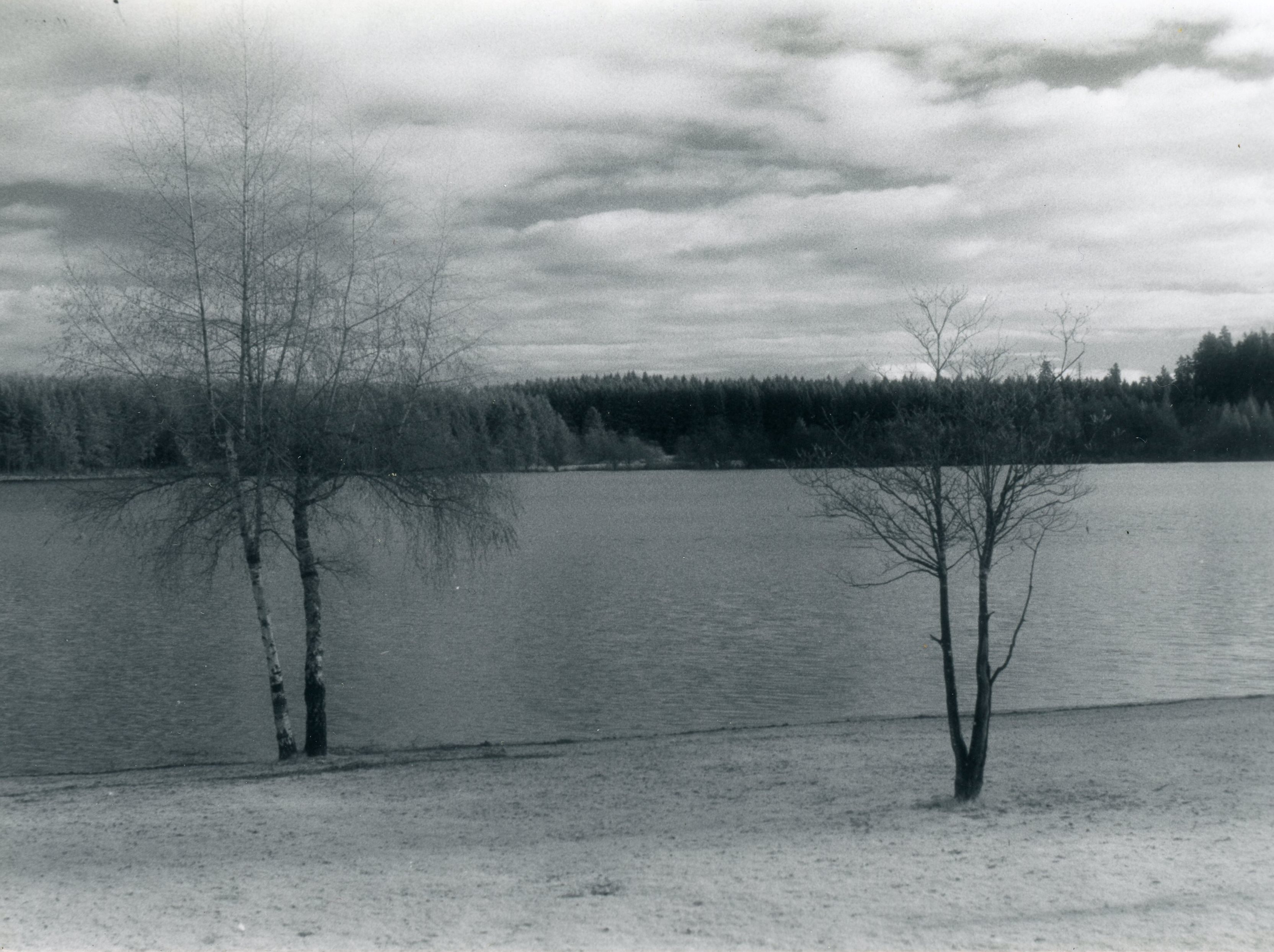
Scott Lake, circa 1980
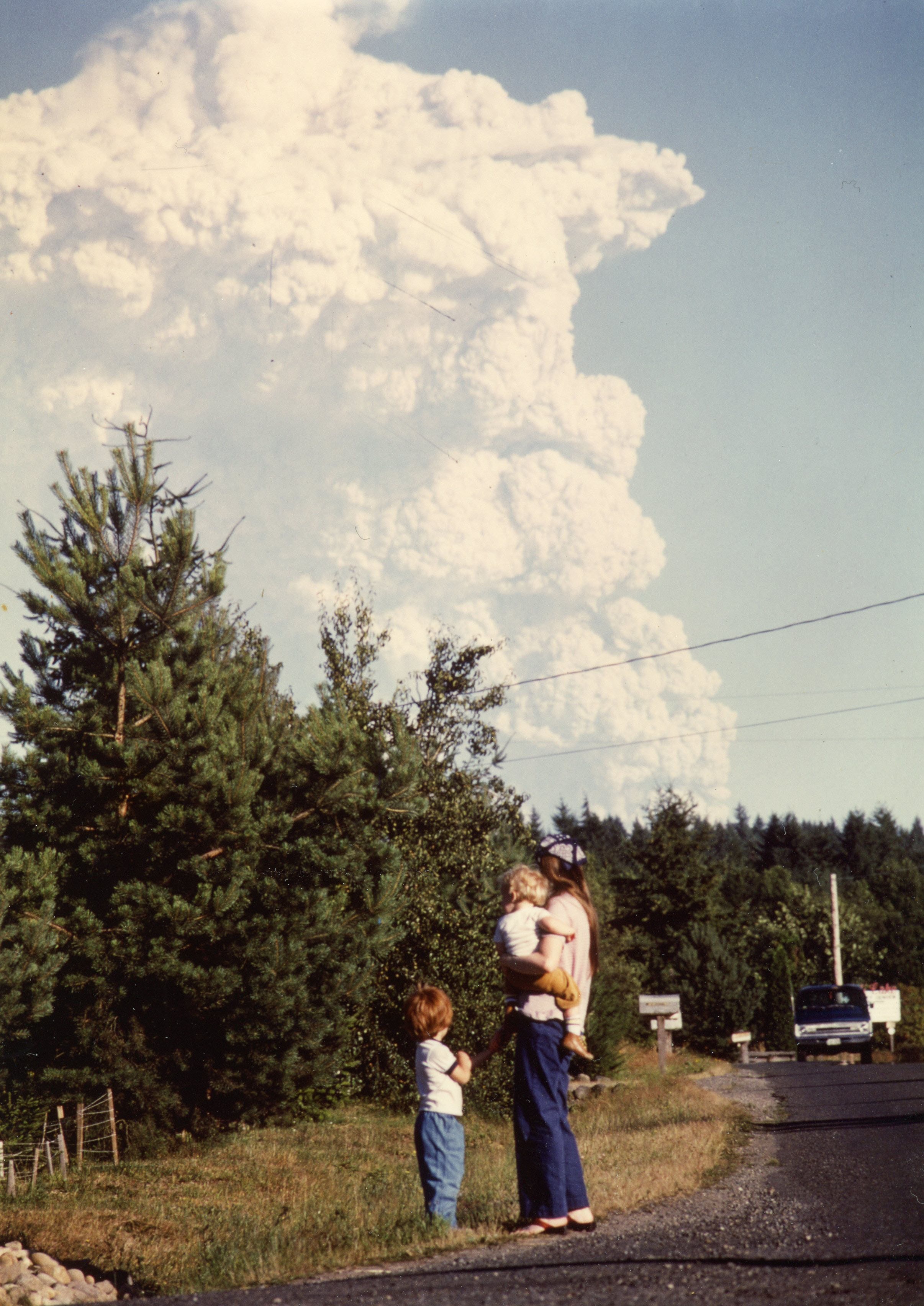
One of Mount Saint Helens's eruptions seen from Scott Lake, July 22, 1980
Lawrence Jacobson was pushing his son Andy Jacobson on the baby swing on August 4, 1991 at the Scott Lake park. Lawr said to Andy, “Look Andy, an airplane.” People noticed that the wheels were below the floats as the plane was landing on the lake. Then, the plane flipped over into the water and made a big splash. People on boats came out to help and rescued the pilot. Fortunately, the pilot wasn't hurt. According to the newspaper article from The Olympian newspaper article the next day, it was a 1947 RC-3 Republic CB airplane.
On December 26, 1996, freezing rain started falling. The freezing rain coated trees and power lines. It took out the power. It was the first known ice storm of its size to ever hit the area (however records of ice storm severity don't go back very far). The power was out for about six days.

Scott Lake community in an ice storm, December 26, 1996
On February 28, 2001 at 10:54 AM PST came the biggest earthquake in nearly 52 years. Its epicenter was at Anderson Island. It lasted about 40 seconds, and the shaking in the Scott Lake vicinity reached 18 cm per second (7 inches per second or 0.4 mph). The acceleration of the shaking reached 16% of the force of gravity. The energy released during the earthquake was 1x10¹⁵ joules, making it a magnitude of 6.8. As big as the quake was, Scott Lake did not lose its power. The earthquake did cause damage to some homes and left cracks in some of the roads. One of the residents on 113th Way lost his $2,000 laptop computer. Another resident on 113th Way had his chimney damaged. Even people who got off lucky as far as damage still had a clean up job, with lots of items all over the floor.
Source for earthquake intensity information: http://earthquake.usgs.gov/earthquakes/shakemap/pn/shake/0102281854/
In summer of 2004, a new swimming dock was put in. Its cost was $12,000.
Powerful winds blew steady from the evening of December 14, 2006 to the early morning of December 15, 2006. This may have been the biggest wind storm in 44 years. Flashes of light in the distance from exploding transformers lit up the night sky. For some reason, the transformers made no noise when they exploded.
The KGY radio station in Olympia was the closest known place that was measuring wind speed during the strongest part of the storm. The power was out at many other places. According to The Olympian article, the KGY radio station recorded a peak gust of 78 mph (126 km/h).
School was canceled the next day. A majority of the Scott Lake Community lost electricity for about three days. 113th Way and a small part of 114th Way were without power for 5 ½ days. The weather after the storm was relatively cold, with nights dipping below freezing. Many people had their wood stoves and generators going.

Aftermath from the Hannukah Eve Windstorm on 113th Way SW, December 15, 2006 9:04 PST
The summer of 2009 had a major heat wave.
Heat Wave of 2009, Olympia Airport Temperatures |
||
| Date | Low °F | High °F |
| July 26, 2009 | 56°F (13°C) | 90°F (32°C) |
| July 27, 2009 | 61°F (16°C) | 97°F (36°C) |
| July 28, 2009 | 63°F (17°C) | 101°F (38°C) |
| July 29, 2009 | 64°F (18°C) | 104°F (40°C) |
| July 30, 2009 | 58°F (14°C) | 95°F (35°C) |
| July 31, 2009 | 56°F (13°C) | 90°F (32°C) |
| August 1, 2009 | 53°F (12°C) | 91°F (33°C) |
| August 2, 2009 | 54°F (12°C) | 92°F (33°C) |
The temperature hit 104°F (40°C) on July 29, 2009 at the Olympia Airport. As of 2013, this was tied as the hottest temperature on record along with 104°F on July 3, 1906 and July 15-16, 1941 at Priest Point Park, and 104°F on August 9, 1981 at the Olympia Airport. A couple of neighbors on 113th Way had unofficial readings of 107°F.
.JPG)
People swimming at Scott Lake in 104°F (40°C) weather, July 29, 2009 5:14 PM PDT
Top Five Hottest Temperatures in History (as of 2014) |
|||
| Rank | Temperature °F | Date | Location |
| 1 | 104°F (40°C) | July 29, 2009 | Olympia Airport |
| 1 | 104°F (40°C) | August 9, 1981 | Olympia Airport |
| 1 | 104°F (40°C) | July 3, 1906 | Priest Point Park |
| 4 | 103°F (39°C) | July 15-16, 1941 | Olympia Airport |
| 5 | 102°F (39°C) | July 20, 1994 | Olympia Airport |
| 5 | 102°F (39°C) | July 1, 1942 | Olympia Airport |
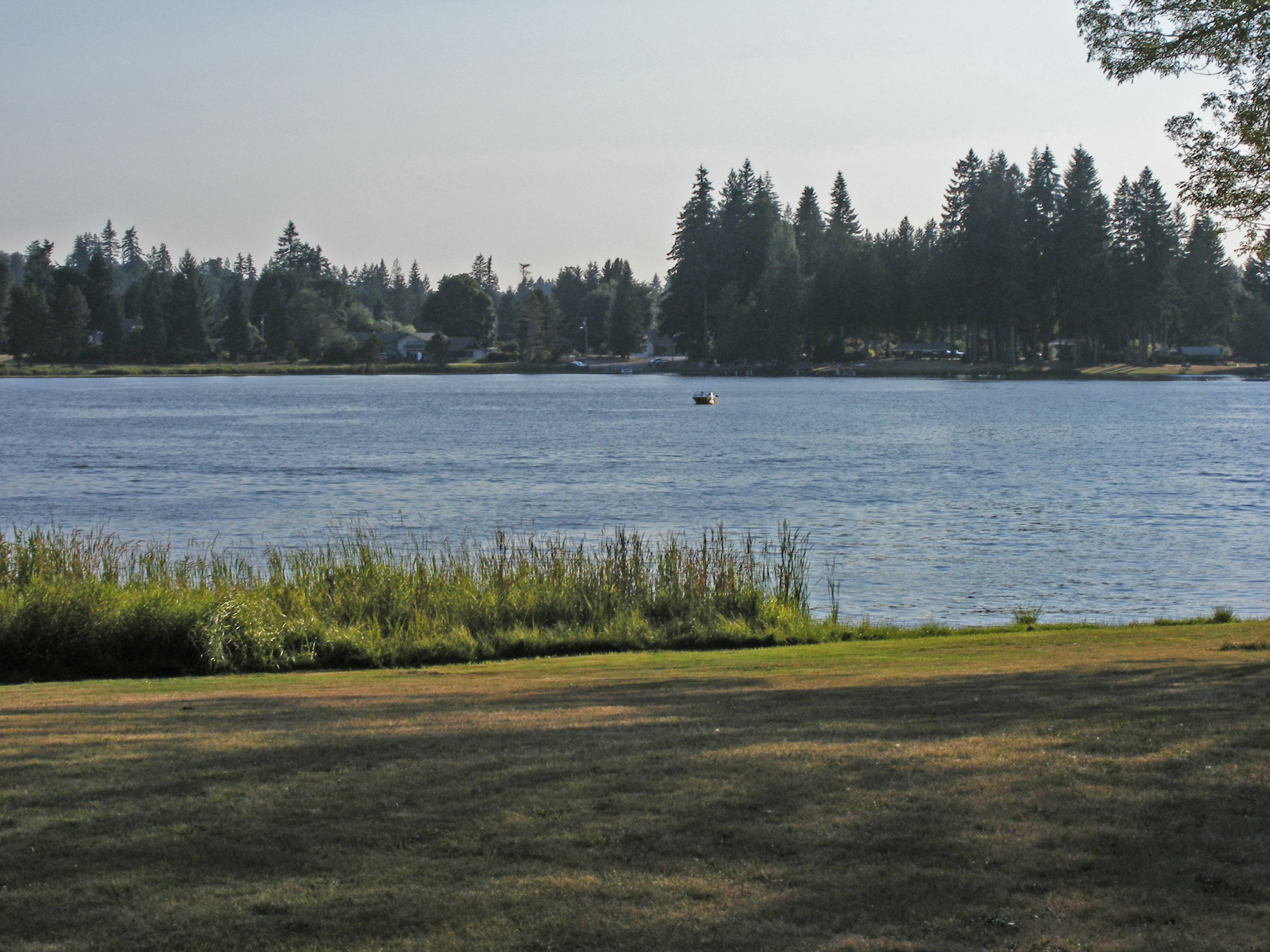
Scott Lake from the side opposite to the park, August 28, 2011 6:00 PDT
15.2 inches (38.6 cm) of snow fell in Scott Lake from January 14 through the 18th. There was 12.1 inches (30.8 cm) of snow on the ground in Scott Lake on January 18, 2012. The lowest temperature reached at the Webster Nursery weather station (called Tumwater SW) on 93rd avenue during that period was 21.4°F (-5.9°C). Current conditions and climatological information for Tumwater SW and other AgWeatherNet stations can be found at http://weather.wsu.edu/awn.php. Many young people were on their four wheelers driving around in the snow. Other people enjoyed free skiing and sledding.
Top Five Deepest Snows in History (as of 2014) |
|||
| Rank | Amount | Date | Location |
| 1 | 36 inches+ (91.4 cm+) | January 9, 1880 | Bush Prairie |
| 2 | 24 inches (61.0 cm) | January 30-31, 1969 | Olympia Airport |
| 2 | 24 inches (61.0 cm) | Winter 1861-1862 | Olympia |
| 4 | 21 inches (53.3 cm) | January 6, 1899 | Priest Point Park |
| 5 | 20 inches (50.8 cm) | January 26, 1972 | Olympia Airport |
On the evening of January 18th, an ice storm began. At about 6:00 PM, the freezing rain began falling. It lasted until about 10:00 AM of January 19th. The freezing rain lasted 16 hours. In that time, 0.82 inches (2.08 cm) of freezing rain fell at the Olympia Airport. This was the second known time that an ice storm of this size hit the area. During the freezing rain, temperatures ranged from 29.2 to 30.9°F (-0.6 to -1.6°C) at Webster Nursery.
The freezing rain left a thick coating of ice on the trees, bushes, and roads. Many branches broke and even whole trees broke in half overnight under the weight of the ice accumulation on top of the snow already on the trees. The power in Scott Lake went out around 7:30 AM on January 19th. That morning, the Emergency Alert System was activated with an ice storm warning.
Even after the freezing rain stopped, branches continued to break all day. The coating of ice did not melt away until the afternoon of January 21st.
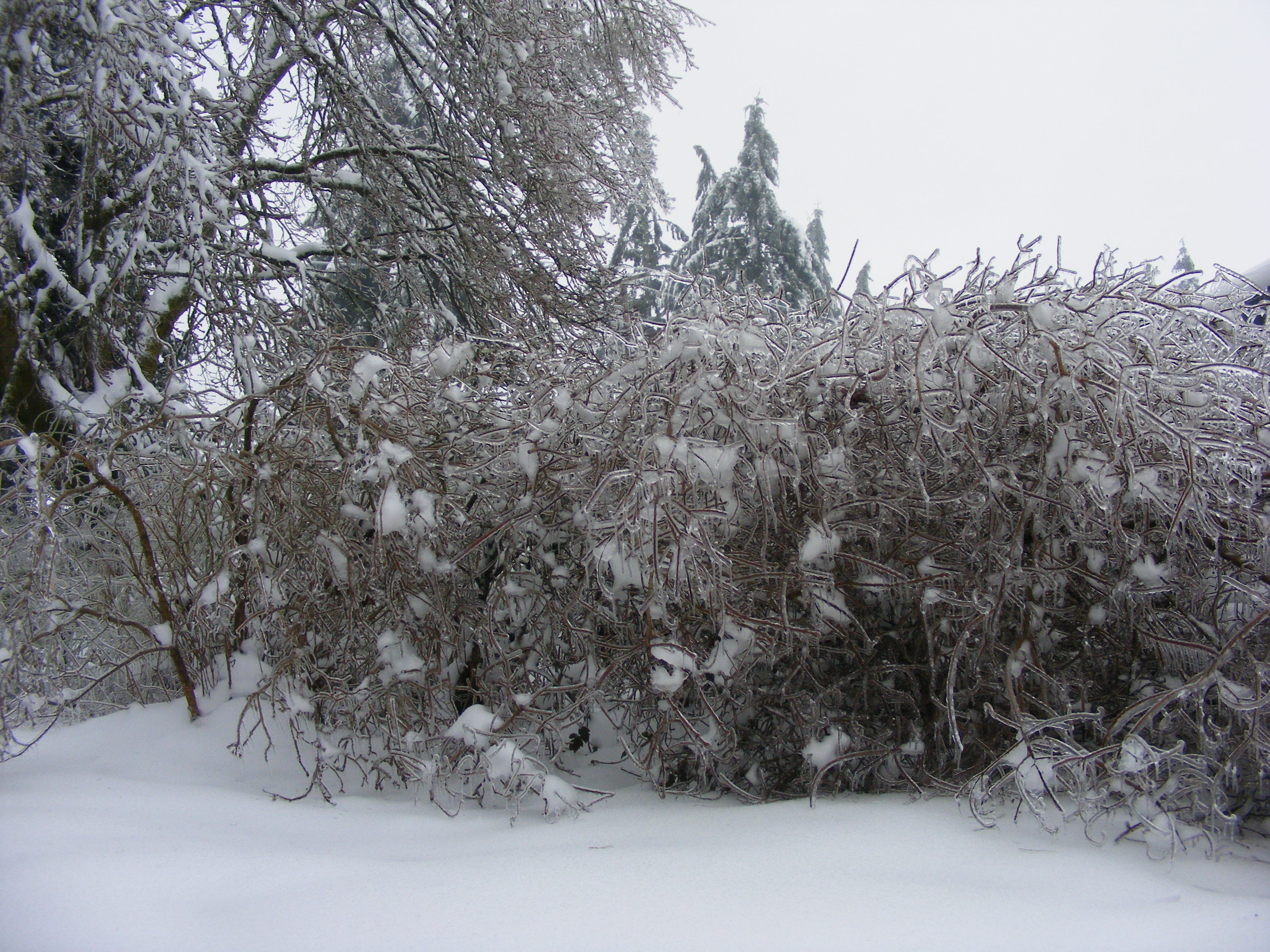
Scott Lake community in an ice storm, January 20, 2012 9:36 AM PST
During the power outage, you could hear the sound of people's generators running outside. Scott Lake Grocery was closed throughout much of the outage. During the power outage, outside temperatures ranged from 27.6 to 47.7°F (-2.5 to 8.7°C).
The power came back on January 23rd around 11:00. The power was out for about 4 ½ days. For those who didn't have a wood stove, by the end of the power outage, indoor temperatures reached 40°F (4°C) in even the most insulated homes.
The clean up from the storm took weeks. The parking lot at the Scott Lake park was designated as a dump spot for all residents of Scott Lake. The pile grew over the weeks until it was hauled away on March 1.
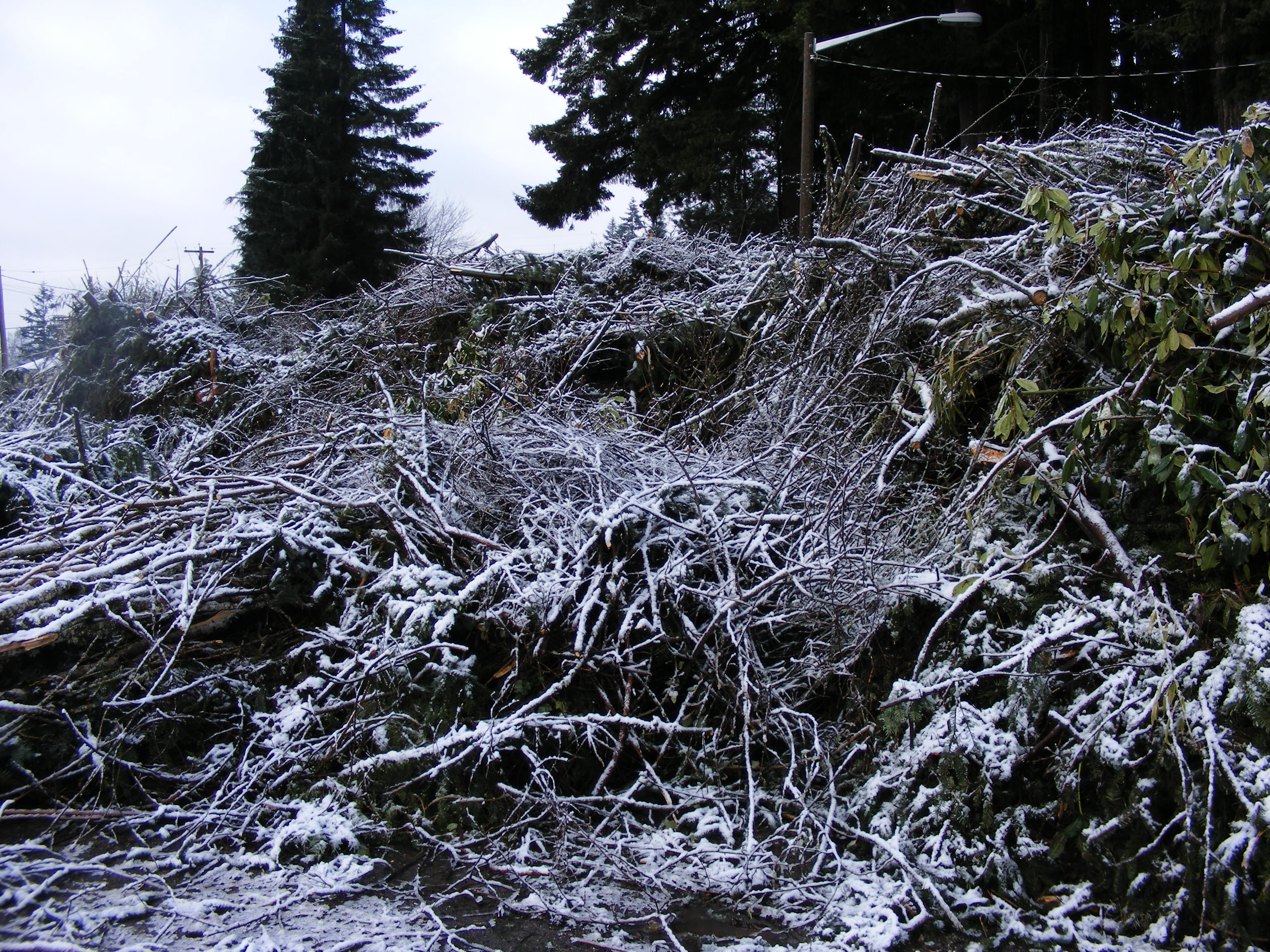
Dump pile from ice storm, March 1, 2012 9:38 AM PST

Trumpeter swans at Scott Lake, February 26, 2012 1:50 PM PST
On March 29th, 2012, the community of Scott Lake turned 50 years old. There were big plans for celebration, but they didn't happen. The only thing that happened was cake being served at the annual board meeting.
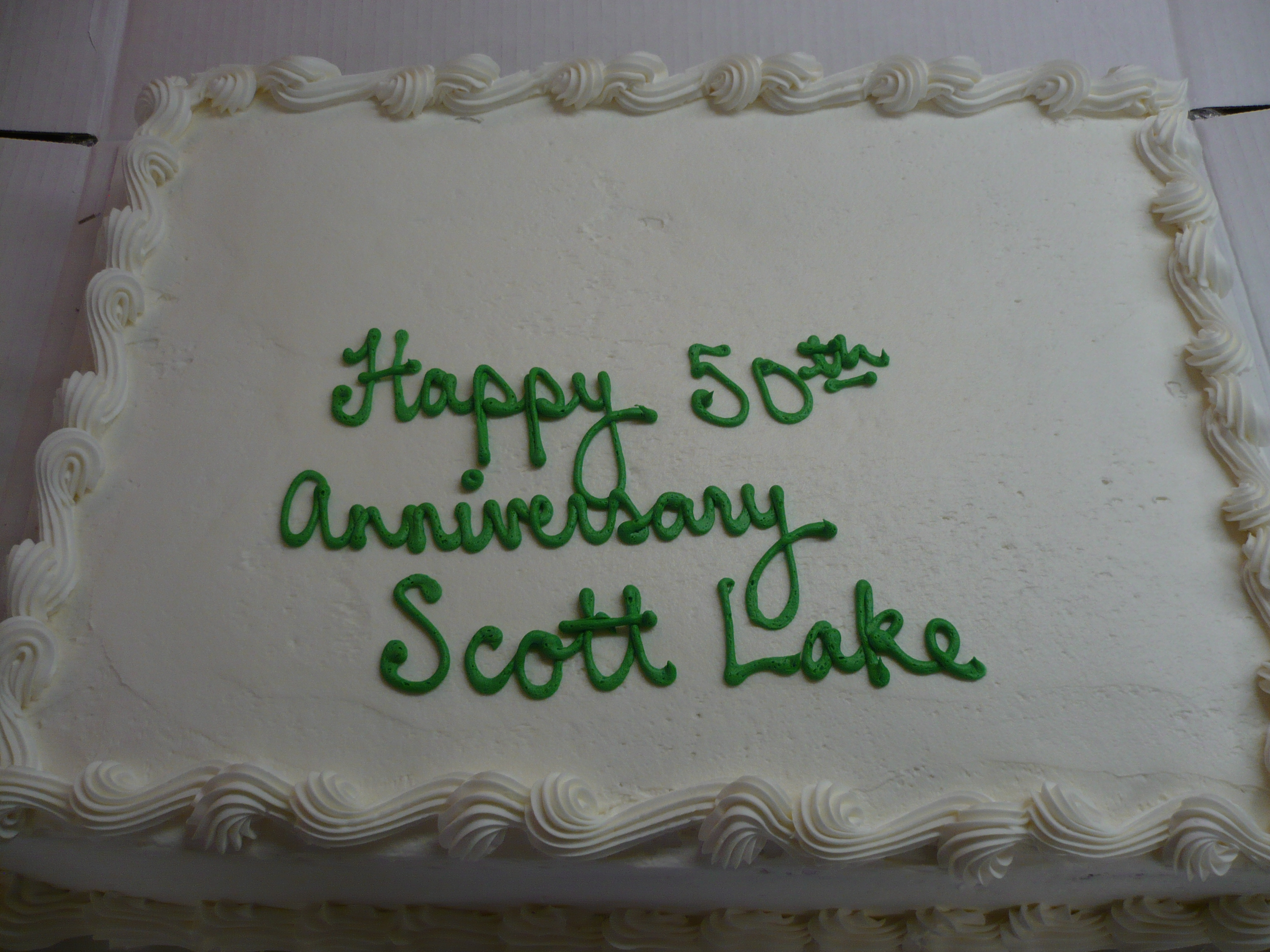
Anniversary cake being served at the annual board meeting, May 19, 2012 10:29 AM
Patrick Hunt, who worked for the Scott Lake Maintenance Company for 40 years passed away at the age of 74 on May 19, 2013. He was born February 20, 1939. The ball field was named Patrick Hunt Ball Field in his honor.
On (blank date), Nathan Reitz launched the Scott Lake History Webpage. Andy Jacobson was the main person involved in creating the webpage and doing research. Others who helped were Clara Jacobson who did some of the research, Jeff Jacobson who helped with some of the computer work, and Lawrence Jacobson who added his knowlege about the community.
